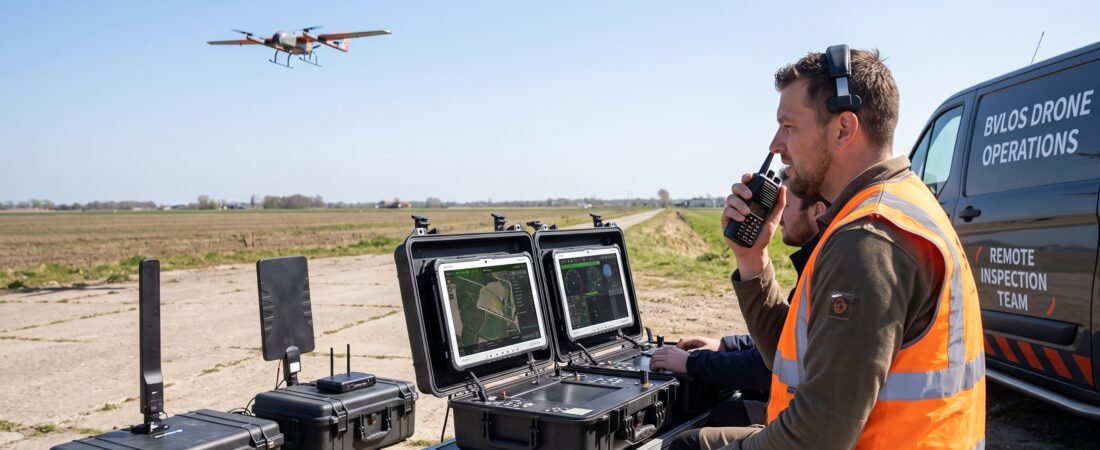
If you’ve spent time preparing for Level 1 Complex Operations (L1CO) or Beyond Visual Line of Sight (BVLOS) flights, you might have stumbled upon one of Canadian aviation’s strangest grey areas. I recently reached out to the pilot community on Reddit to get a real-world perspective on how crews are handling a clear conflict between Transport Canada guidance and ISED radio licensing rules.
The Regulatory Tug-of-War
On one side, Transport Canada (TC) expects RPAS crews in Advisory Circular AC 903-001 to monitor and broadcast position reports on local VHF airband frequencies (ATF/MF) to maintain situational awareness with manned aircraft.
On the other side, Innovation, Science and Economic Development Canada (ISED) governs the airwaves. ISED rules dictate that holding a Restricted Operator Certificate-Aeronautical (ROC-A) isn’t enough on its own—the physical radio transmitter must belong to a licensed aeronautical station (such as a registered aircraft or a fixed ground station). A handheld radio used by a drone crew standing in a field technically doesn’t qualify, making routine airband broadcasts a regulatory violation under strict ISED rules.
What Pilots in the Field Are Actually Doing
When I posed this dilemma to experienced operators, the consensus was surprisingly consistent: practical airmanship and immediate safety take priority over bureaucratic gridlock.
- The Emergency Override: Pilots pointed out that radio regulations allow licensing technicalities to be overridden during a true emergency or when an immediate threat to aviation safety exists.
- Continuous Monitoring: Rather than making routine 5-minute blind calls that might trip regulatory wires or clutter frequencies, drone crews keep an airband transceiver on to monitor local traffic actively.
- Transmitting During Conflicts: Operators only key the mic and transmit if an incoming manned aircraft presents a potential collision risk or clear situational awareness hazard.
The Practical Takeaway for RPAS Crews
Until TC and ISED resolve this years-long administrative stalemate, operating safely requires a balanced, common-sense approach:
- Maintain Your Credentials: Ensure your radio operators hold a valid ROC-A certificate.
- Scan the Airwaves: Always monitor local ATF/MF frequencies while operating in uncontrolled airspace.
- Prioritize Safety Above All: If a manned aircraft is closing in on your volume of airspace, key the mic and speak up. No safety board will penalize a pilot for making a clear broadcast that prevented a mid-air conflict.